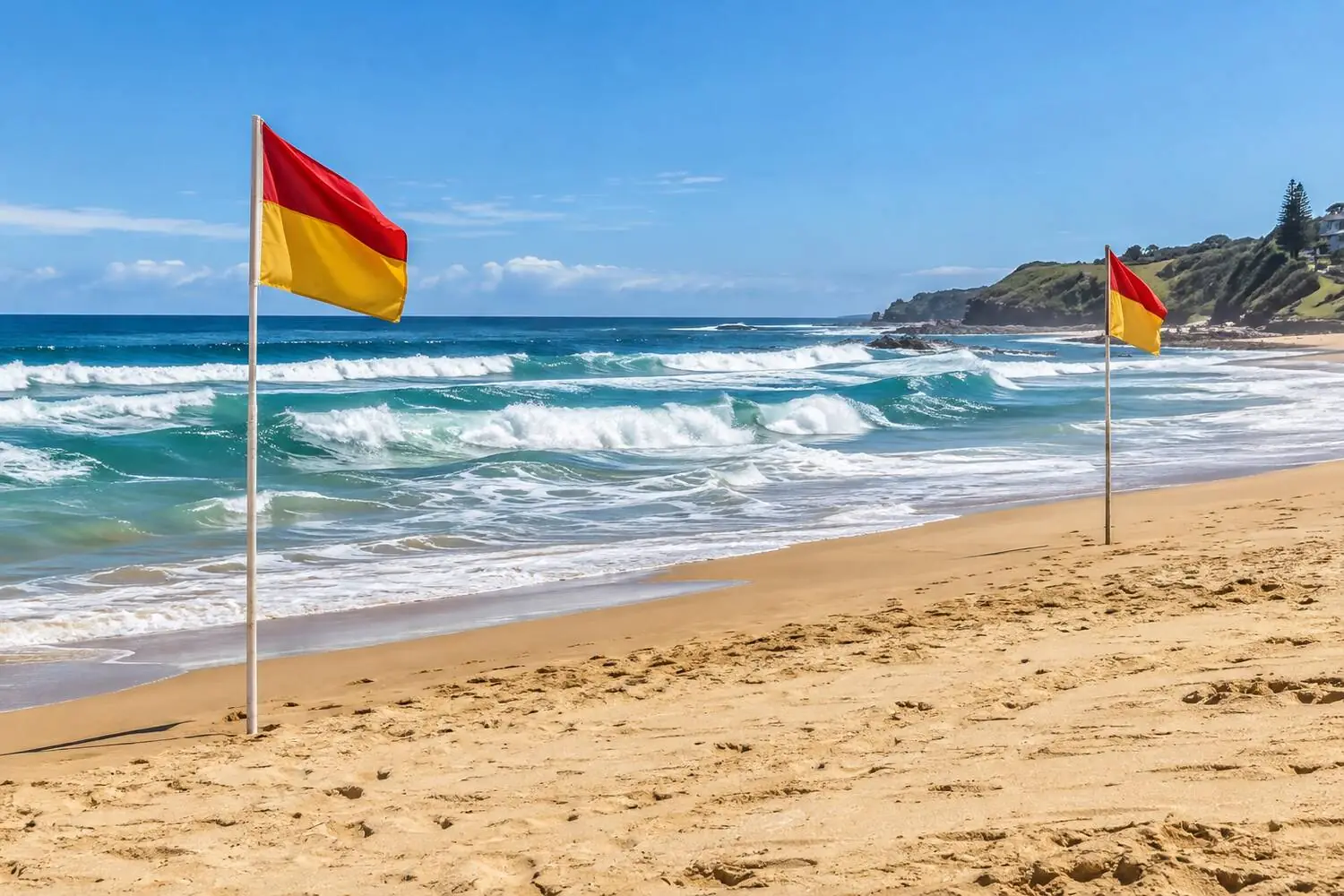
The single most important rule on any Australian beach: swim and surf between the red-and-yellow flags, on a patrolled beach, whenever you can. Those flags mark the safest stretch of water, watched by surf lifesavers. Most drownings happen on unpatrolled beaches — and most involve rip currents.
Rip currents — the big one
A rip is a concentrated flow of water heading back out to sea. It won't pull you under; it pulls you out. Panic and exhaustion are what make rips dangerous, not depth.
How to spot a rip
- A darker, deeper, calmer-looking channel where the waves aren't breaking.
- A gap in the line of breaking white water.
- Surface ripples, foam, sand or seaweed moving steadily offshore.
If you're caught in a rip
- Stay calm and conserve energy — don't try to swim straight back against it.
- Raise one arm to signal for help and float — lifesavers will come to you.
- If you can, swim parallel to the beach toward the breaking waves and white water, which will help push you back in.
- Never swim out after someone in trouble — alert a lifesaver or call 000. Would-be rescuers are among the most common rip drownings.
Know before you go — the Beachsafe app
Surf Life Saving Australia's free Beachsafe app (iOS and Android) lists every beach in the country with its patrol status, hazards, facilities, weather, swell and tide — plus alerts for rips, marine creatures and pollution. Check it before you drive to the coast, and choose a patrolled beach if you're unsure.
Sun & marine life
Australia has some of the world's most intense UV. Slip on a rash vest, slop on SPF50+, slap on a hat, seek shade and slide on sunglasses — and reapply often, especially on the water.
- Sharks are present on every coast. Avoid dawn and dusk, murky water, river mouths and areas with baitfish or seals; always heed beach closures and shark alerts.
- Bluebottles are common, especially on onshore winds. If stung: don't rub it; pick off tentacles; rinse with sea water (not fresh); immerse in comfortably hot water for about 20 minutes. Vinegar is for tropical stingers up north — not bluebottles.
- Rock and reef edge many of the best breaks (Bells, Margaret River, Lennox, Cactus). Know your entry and exit before you jump in.
Surf etiquette & right of way
The line-up runs on unwritten rules that keep everyone safe:
- The surfer closest to the breaking peak has priority on the wave.
- Don't drop in on a wave someone is already riding — it's the cardinal sin and causes collisions.
- Don't "snake" around others to steal priority, don't ditch your board, and wait your turn.
- Respect locals, help anyone in trouble, and never surf alone — especially at remote or reef breaks.
When to go, and how much rubber to pack.
Australia's coasts face different oceans, so the surf — and the water temperature — changes dramatically between them. These are general guides; always check the live forecast.
Warm & forgiving
The warmest surf in the country — roughly 24–27 °C in summer–autumn, 20–22 °C in winter. A rash vest or light springsuit is usually plenty. Best on NE/E cyclone and tropical swells; autumn is the classic sweet spot.
Year-round variety
Around 22–24 °C in February, down to 16–18 °C by August — a spring suit in summer, a 3/2 mm steamer in winter. A steady mix of E/SE wind swells and big S groundswells, with glassy mornings before the afternoon sea breeze.
Cold & powerful
Exposed to the Southern Ocean and the most consistent heavy swell. Water around 17–20 °C late summer, 12–14 °C in winter — pack a 4/3 mm minimum, 5/3 mm and boots when it's cold. Big SW/S groundswell needs a N/NW offshore to clean up.
Raw & reliable
Relentless Indian and Southern Ocean SW swell — among the most reliable in Australia, and among the most serious. Margaret River sits near 16–22 °C through the year; South Australia is colder and shark-aware. Spring suit in summer, 4/3–5/3 mm in winter. Autumn–winter is prime.